

The research team works with lived experience to support older people living with dementia and address loneliness in international students.
UNSW Arts, Design & Architecture’s Scientia Professor Jill Bennett, who is Director of UNSW AI-companion research program, leads a research team that has developed a suite of AI skilled companions. These digitally embodied screen-based AI companions are specifically trained to provide psychosocial support for different communities.
The team is multi-disciplinary, mixing psychosocial expertise, design and creative expertise, computer science and AI. They are also increasingly working with the School of Social Work as well as clinicians across UNSW.
Many big tech companies have similar off-the-shelf products, but what’s distinctive about Jill and her team is that from the start they work on the ground with lived experience and tailor solutions to the context.
“We always work from a specified need and the feedback so far has been positive,” said Jill. “So when people say they’re lonely, we look at what type of conversation they want to have so it’s not a blanket prescription.
“We know chatbots aren’t the answer to everything and they can be annoying. Our view is that AI is here and we need to engage, but we are not AI crusaders.”
Addressing loneliness in aged care
The Australian Research Council Laureate felt Experience & Empathy Lab [fEEL] has developed a suite of AI digital companions made with and for older people.
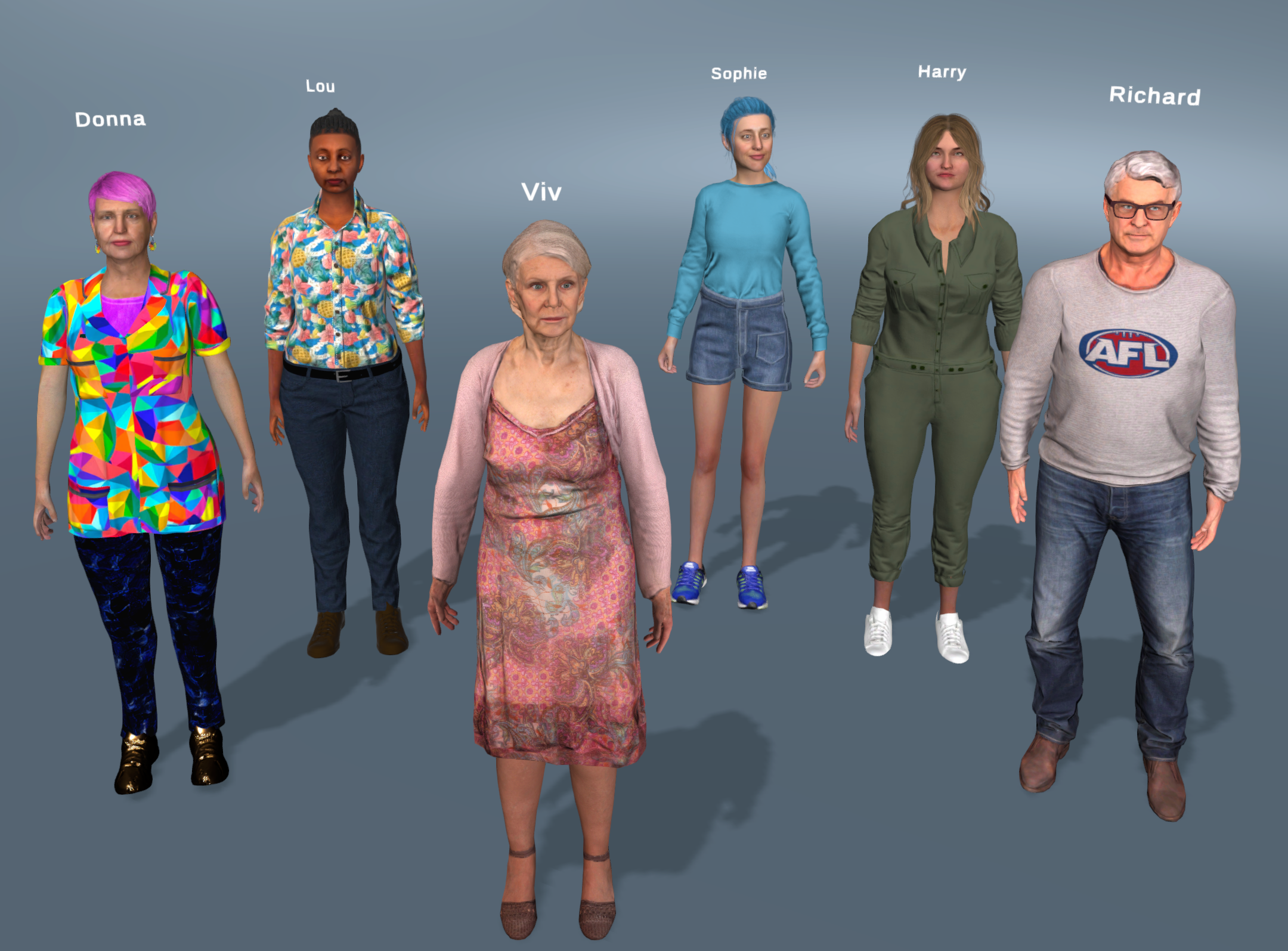
AI skilled companions for aged care, Viv and friends.
“We do a lot of work with aged care and have developed AI companions for people living with dementia and other neurodegenerative conditions,” said Jill. “Our trials work with people with lived experience and we also partner with UNSW’s Centre for Healthy Brain Ageing [CHeBA].”
A focus of the team has been loneliness and isolation, where sometimes a chatbot can be more effective than a human.
“For example, an older person may have lost their life partner and they’re grieving. They don’t want to go out and meet people, nor do they want to be silent. They might just want to talk about their grief. An AI companion with infinite patience and enough skill to respond in this situation can be helpful,” said Jill.
Although this may fill a gap in an aged care setting, the AI companion needs to suggest other pathways and not present itself as a substitute human.
“There is an ethical shift at the moment towards ensuring that a chatbot is clear about its AI status, particularly with the move to ultra realism.
“It’s not to say that you can’t have a deep engagement, but the relationship we have with AI will always be different from the relationship we have with a human. If we understand what we can get from one and not the other, we become more sophisticated users,” Jill said.
AI companions for Chinese/Mandarin-speaking students
The team has recently been working with Chinese international students at UNSW. It came from talking with students to understand their struggles with language and the real barriers that can produce bad mental health outcomes. The project is looking at the kind of support and resources that would be useful for them in their everyday lives.
“We’ve developed an AI companion prototype that speaks both English and Mandarin. We are currently testing and role playing to see how good these companions are at providing useful support. We are looking for quality conversations that can help process difficult thoughts and feelings,” Jill said.
The team is trying to address the loneliness some students can feel when they find themselves in a place where they don’t necessarily have networks and where language can be a barrier.
“The AI companions don’t replace a professional therapist. But if you’re feeling down and depressed, our goal is for them to be able to have a relatively skilled conversation the kind you might have with a friend, attuned to your situation. The idea is to hold a conversation and help students work through difficulties.
“It’s about having access to something that can provide useful support in the short term. The great thing is that they’re multi-use. If you’re up in the night distressed, they can help you regulate, but you can also talk to them about music, your essay, anything,” said Jill.
“We are training these AI companions to be relatable, fun to talk with and play the role of a friend able to offer psychosocial support.”
By building trust and working with a community of users, the issue of an overly agreeable chatbot that just validates everything you say and lets you get away with quite bad behaviour can be avoided.
“Just like a good friend would challenge you, you need support and understanding to talk about what’s underlying,” Jill said.
“Large language models like Chat GPT are pulling back on the agreeability of chatbots because it’s too excessive. We know it’s not good for someone’s mental health to just agree with everything you say, you need some resistance to gently challenge people. Training a chatbot to have those kinds of skills is very important and it’s something we keep testing and working on.”
From working with older people, the team have learnt that those people who feel isolated have a need to speak with others. It can make a huge difference to their mental health.
“It’s about everyday engagement and being able to bounce off ideas and to destress by offloading. If you have an AI agent that is skilful enough to help someone down regulate and think through good options rationally, that’s a good result,” Jill said.
(Photo top: 陪伴 (péi bàn) – AI companion (Tom & Mia)).
Meet the Chinese/Mandarin speaking AI companion
Students and staff are invited to the launch of our Chinese/Mandarin speaking prototype as part of a week-long festival on the theme of loneliness. The festival runs from Monday 13 April to Friday 17 April.
Join the official launch:
Date: Tuesday 14 April, 5pm
Location: Health Translation Hub (HTH)
Register to attend the launch and visit loneliness and being alone festival for more information.
- Log in to post comments